Best Interactive Cat Toys for Indoor Cats
Indoor cats need to hunt, even if the prey is fake. This guide covers the toy types that satisfy real feline instincts, how to rotate them, and which ones are worth buying.
Why indoor cats need hunting play
A cat that lives indoors is safer and lives longer on average, but it pays a price: boredom. In the wild, a cat spends hours a day on the hunt stalk cycle of stalk, chase, pounce, and catch. Take that away and the energy has to go somewhere, which is how you get 3 a.m. zoomies, shredded furniture, and cats that harass their housemates.
Interactive play is the replacement. The goal is not just exercise, though that matters for weight control. The real goal is letting the cat complete the predatory sequence. A toy that moves unpredictably, makes small sounds, or hides and reappears triggers the same brain circuits as real hunting. A cat that gets two or three good play sessions a day is calmer, sleeps better, and causes far less trouble.
Kittens need this most because play is how they learn coordination, but senior cats benefit too. An older cat will not chase like a kitten, but gentle batting and pouncing keeps joints mobile and minds sharp.
The toy types that actually work
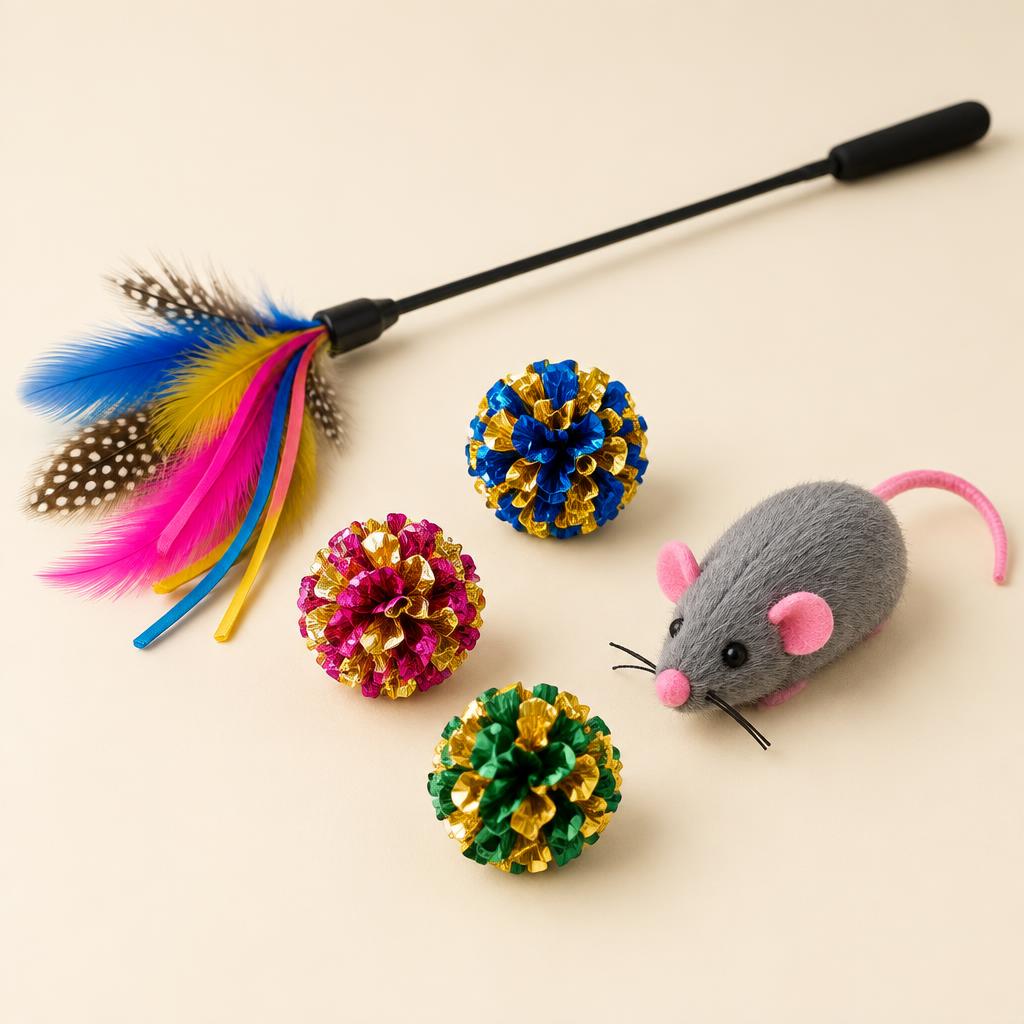
Cat toys fall into a few functional categories, and the best toy boxes have at least one of each. Chase toys move on their own or roll unpredictably, triggering the pursuit instinct. Pounce toys are small, grabbable, and satisfying to bunny-kick. Teaser toys let you be the prey, which builds the bond between you and the cat while giving you control over the difficulty.
For solo play when you are not home, motion-activated toys are the stars. The Interactive Chirping Cat Ball Toy with Catnip (3-Pack) is a strong example: it chirps like real prey, rolls on its own, and the catnip keeps cats coming back. Having three in the pack means you can rotate them so they stay novel.
For classic batting and carrying, simple is often best. The Catnip Cat Play Ball and the Long-Tail Mouse Cat Toy are the kind of toys cats choose themselves: small, easy to grab, and with textures and tails that invite the full grab-and-kick routine. And for play sessions you lead, the Electric UFO Cat Teaser Toy with Bell combines erratic motion with sound, which is irresistible to most cats and gives you an easy way to run a high-energy session before dinner.
- Chase toys: balls and rolling toys that move unpredictably
- Pounce toys: small mice and kickable shapes for grabbing
- Teaser toys: wand-style toys you control for interactive sessions
- Solo-play toys: motion or sound-activated toys for when you are away
Solo play vs. playtime with you
Both matter, and they do different jobs. Solo-play toys like the Rotating Catnip Cat Toy keep a cat occupied during the day, which is when most indoor cats are alone and bored. Look for toys with automatic shutoff so they do not run all day and become background noise the cat ignores.
Interactive sessions with you are where the real bonding and exercise happen. Ten to fifteen minutes, once or twice a day, is enough for most adult cats. Move the teaser like prey: skitter it away, let it hide behind furniture, pause so the cat can stalk. Always end with a catch. Letting the cat grab the toy at the end completes the hunting sequence, and following the session with a meal mirrors the hunt-eat-groom-sleep rhythm of a real cat's day.
If your cat loses interest halfway through, you are probably moving the toy too fast or too predictably. Slow down, add pauses, and let the cat's eyes tell you when it is locked on.
Rotate toys or watch them die of boredom
Cats habituate fast. A toy left on the floor for two weeks becomes furniture. The fix is rotation: keep two or three toys out and store the rest, then swap the set every week or so. A toy that reappears after ten days is suddenly interesting again.
This is another reason multipacks earn their keep. With the Interactive Chirping Cat Ball Toy with Catnip (3-Pack), you can keep one in play and two in the drawer, cycling them so each one feels new. The same works with the small balls and mice: put half away and rotate.
Also refresh the catnip. Dried catnip loses potency in a few weeks once exposed to air. Store toys with catnip in a sealed bag or jar between rotations, and replace loose catnip monthly. About half of cats do not respond strongly to catnip at all, by the way, which is genetic and completely normal. For those cats, silvervine or valerian-root toys are worth trying.
Safety checks before you buy
Most cat toys are safe, but a quick inspection habit prevents the rare problems. Check for small parts that can be chewed off and swallowed: glued-on eyes, loose bells, fraying strings. String and ribbon toys should be put away after play, not left out, because linear foreign bodies are one of the more common surgical emergencies in cats.
Electronic toys should have enclosed battery compartments that a cat cannot pry open. Supervise the first few sessions with any new motorized toy until you know how your cat plays with it. And inspect plush toys periodically for tears; a toy that is falling apart should be retired before stuffing becomes a snack.
None of this is meant to scare you off. Millions of cats play with these toys safely every day. It is just the two-minute check that keeps it that way.
The bottom line
Indoor cats need to hunt, and the right toys let them do it safely. Stock a mix: motion toys like the Interactive Chirping Cat Ball Toy with Catnip (3-Pack) and the Rotating Catnip Cat Toy for solo play, simple grab toys like the Catnip Cat Play Ball and Long-Tail Mouse Cat Toy for batting and kicking, and a teaser like the Electric UFO Cat Teaser Toy with Bell for sessions you lead. Rotate them weekly, end play sessions with a catch and a meal, and do a quick safety check on anything new. Do that consistently and you will have a calmer, leaner, better-behaved cat.
Go deeper with a full course
Our vet-led courses turn these guides into step-by-step lessons — with lifetime access and progress tracking.